California and Nevada Smoke and Air Committee
|
California and Nevada Smoke and Air Committee |
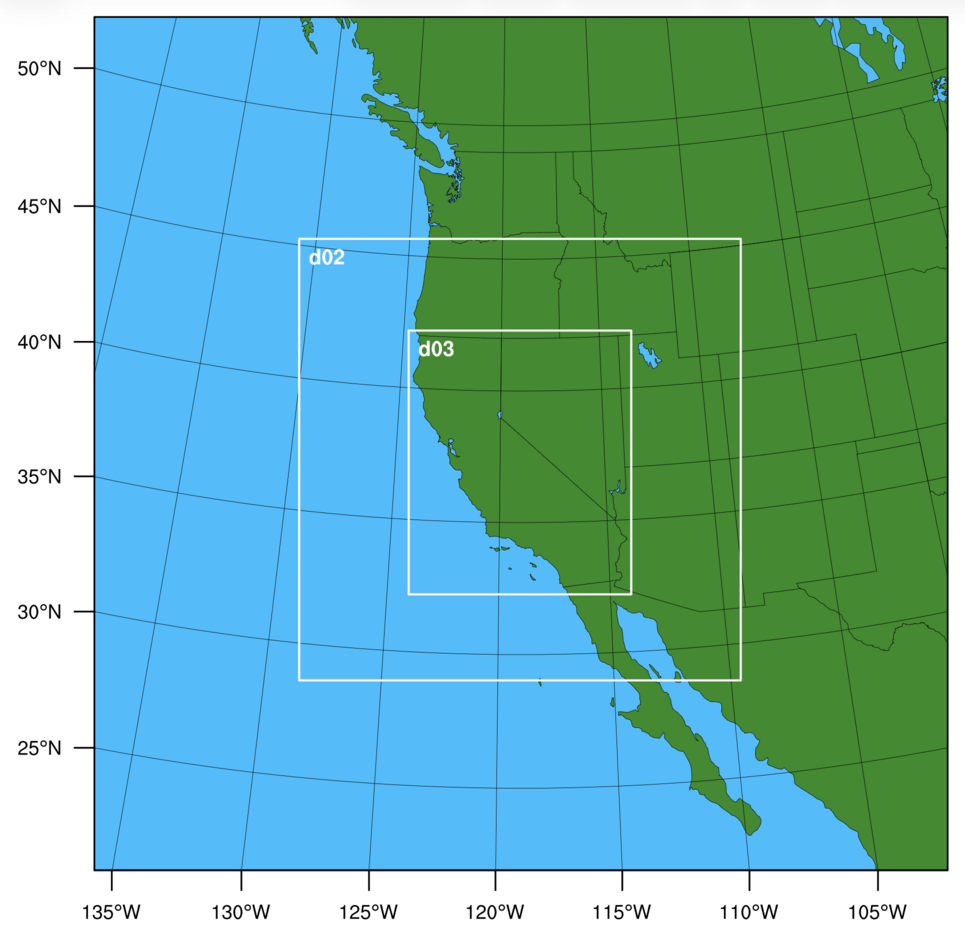
1-km WRF Model ConfigurationThe Weather Research and Forecasting (WRF) Model employs the Lambert Conformal map projection centered at 38N, 119W and consists of three nested grids. The outermost grid (9 km horizontal resolution, 401x401x40 grid points) covers the western U.S., parts of Mexico/Canada, and the eastern Pacific. The nested grid (3 km horizontal resolution, 622x622x40 grid points) encompasses California, Nevada, Oregon, Utah, and parts of Idaho, Arizona, Wyoming, and Montana. The innermost grid (1 km horizontal resolution, 940x1114x40 grid points) encapsulates the entire California and Nevada boundaries.
Twice daily forecasts are initialized using NOAA's RRFS model (https://gsl.noaa.gov/rrfs/) 00/12 UTC forecast outputs (13 km resolution) at 7 AM/PM PST. Currently, the real-time system generates 72-hr forecasts for all grids. The model outputs are saved in hourly intervals. The CANSAC real-time system utilizes the WRF model version 4.8.0 in a non-hydrostatic mode with two-way nesting. The vertical layers consist of 40 hybrid sigma-pressure vertical levels for each grid. The model physics options used in the current configuration are given here:
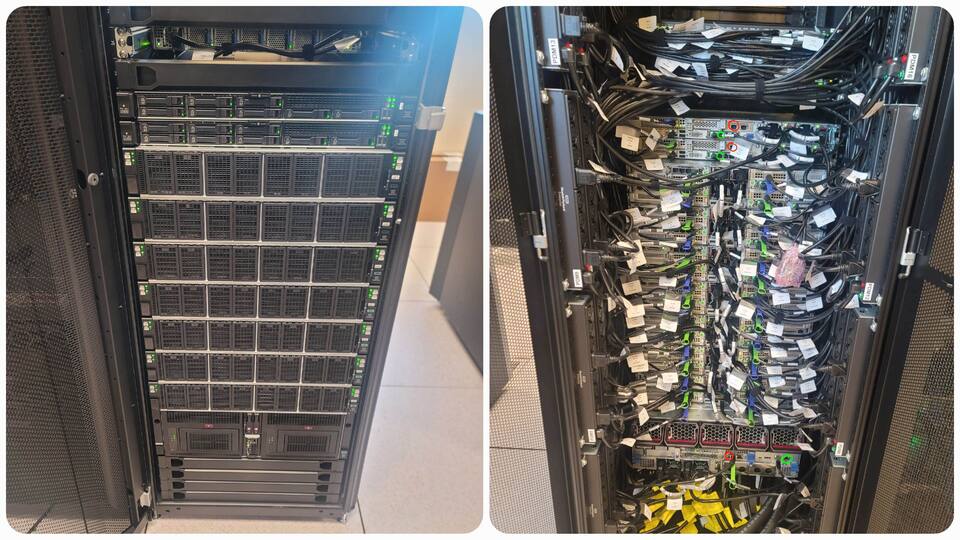
Postprocessing The CANSAC WRF real-time system uses the RIP (Read/Interpolate/Plot) version 4.7 visualization program along with NCL NCAR Command Language, GrADS, and Python scripts for all post-processing products. The code is being continuously improved to meet the needs of CANSAC users. Currently the set of visual products includes plots of ventilation index, Haines index (high and mid levels), lifted index, cloud water, planetary boundary layer height, precipitation, absolute vorticity and sounding plots/text files along with other standard parameters used in weather forecasting and atmospheric assessment applications. The model runs 3 domains, out to 72 hours in about 1 hour 45 minutes wall clock time and the entire post-processing is completed within about 2.5 hours. WRF output files are roughly 1.85GB for all three domains per each hour (D1: 200MB, D2: 450MB, D3: 1.2GB). HardwareThe CANSAC WRF real-time forecast system is operated on an HPE Apollo 2000 high-performance computer. Specifications are:
|